


Technical Ceramic Materials
HOME >> CERAMIC MATERIAL
Microns Advanced Ceramics manufactures precision components in alumina, zirconia, silicon carbide, silicon nitride, aluminum nitride and boron carbide. This page exists to help you pick the right one — with the property values side by side, and an honest account of where each material stops working.
If you already know your material, go straight to its page. If you are choosing between two, the comparison chart below is the fastest route. If you are not sure the application suits ceramics at all, start with our guide to ceramic materials.


━━◆━━ Material Overview
Which Ceramic Material Does Your Application Need?
Most material selection errors in technical ceramics come from optimising a single number. A buyer needs "the hardest material" and specifies boron carbide into an application with bending loads, where its 2.9 MPa·m^0.5 fracture toughness makes it the worst available choice. Or a buyer needs "high temperature" and specifies zirconia into a 1,400 °C furnace, where it will creep and destabilise long before alumina would.
Ceramics are unforgiving in one specific way: they do not warn you. A metal part that is overloaded yields, deforms visibly and keeps functioning for a while. A ceramic part that is overloaded fractures, completely, and usually without warning. So selection is less about finding the strongest candidate than about finding the one whose failure mode your design can tolerate.
The comparison charts below give the numbers. The selection guide below them gives the reasoning.
Technical Ceramic Material Comparison Chart
Typical values for standard production grades. Actual properties vary with purity, grain size, density and forming method, so request the grade-specific datasheet before you finalise a design.
Material | Density (g/cm3) | Vickers hardness (HV) | Flexural strength (MPa) | Fracture toughness (MPa m^0.5) | Max use temp in air (C) | Thermal conductivity (W/m K) | Thermal expansion (x10-6 per K) | Dielectric strength (kV/mm) | Volume resistivity (ohm cm) | Relative cost |
|---|---|---|---|---|---|---|---|---|---|---|
Alumina 96% | 3.72 | 1,100-1,200 | 330 | 3.5 | 1,500 | 24 | 8.2 | 15 | >10^14 | $ |
Alumina 99.5% | 3.90 | 1,400-1,600 | 380 | 4.0 | 1,700 | 30 | 8.4 | 17 | >10^14 | $$ |
Zirconia 3Y-TZP | 6.05 | 1,200-1,300 | 900-1,200 | 8-10 | 1,000 | 2-3 | 10.5 | 10-12 | >10^13 | $$$ |
ZTA | 4.10-4.30 | 1,400-1,500 | 500-600 | 5-6 | 1,500 | 20-25 | 8.5 | ~15 | >10^13 | $$ |
Silicon carbide (SSiC) | 3.10-3.15 | 2,400-2,800 | 400-450 | 3.0-4.0 | 1,600 | 120-150 | 4 | n/a | 10^2-10^6 | $$$ |
Silicon nitride (GPSSN) | 3.20-3.25 | 1,400-1,600 | 700-900 | 6.0-7.0 | 1,200 | 25-30 | 3.2 | 15-18 | >10^13 | $$$$ |
Aluminum nitride (AlN) | 3.26 | 1,100-1,200 | 300-350 | 2.6 | 900 | 170-200 | 4.5 | 15-17 | >10^14 | $$$$ |
Boron carbide (B4C) | 2.52 | 2,900-3,300 | 350-400 | 2.9-3.7 | 800 | 30-40 | 5 | n/a | ~10^5 | $$$$ |
Reading the chart. Three columns do most of the work:
-
Fracture toughness tells you how much the material forgives. Zirconia at 8–10 MPa·m^0.5 tolerates handling, assembly stress and mild impact that would shatter boron carbide at 2.9.
-
Thermal expansion tells you whether the part can be joined to metal. Silicon nitride at 3.2 ×10⁻⁶/K is a poor match for stainless steel at 17; alumina at 8.4 is closer but still needs a compliant joint.
-
Thermal conductivity splits the electrical materials in two. Alumina insulates and blocks heat. Aluminum nitride insulates and moves heat at 170–200 W/m·K — which is why it costs four times as much and why it exists at all.
━━◆━━ Our Materials ━━◆━━
Our Ceramic Material Range
Six materials, six different jobs. Each entry below gives the property profile, the applications it suits, and the conditions under which it should not be specified. Follow the link on any material for full datasheet detail and component examples.

Alumina (Al₂O₃)
-
Where most technical ceramic projects should start, and where a good proportion should finish. It is the best-understood, most widely machined and most economically available technical ceramic, and it is good at three things at once: electrical insulation, wear resistance and high-temperature stability.
-
We supply 95%, 96%, 99.5% and 99.9% purity grades. Purity is not a marketing ladder, it changes the material. Higher purity means less glassy grain-boundary phase, which raises strength, thermal conductivity and dielectric strength, and improves plasma resistance in semiconductor environments. It also raises cost and makes the material harder to machine.
-
Specify it when you need an electrical insulator that also has to survive heat or abrasion, a wear part at reasonable cost, or a semiconductor-grade component at 99.5% purity and above.
-
Do not specify it when the part sees bending or impact loads and cannot be redesigned into compression. Alumina's 3.5–4.0 MPa·m^0.5 toughness is low even by ceramic standards.

Zirconia (ZrO₂)
-
The ceramic you specify when the part has to survive being handled. Its flexural strength (900–1,200 MPa) and fracture toughness (8–10 MPa·m^0.5) are the highest of any monolithic oxide ceramic, by a wide margin.
-
That toughness has a mechanism behind it. Yttria-stabilised tetragonal zirconia holds a metastable tetragonal phase at room temperature. When a crack tip stresses the material, grains at the crack front transform to the monoclinic phase and expand by roughly 4% in volume, clamping the crack shut. The material actively resists its own fracture.
-
The trade-off is temperature and thermal conductivity. Above about 1,000 °C in service, and especially in humid conditions between 150–400 °C, that same metastable phase can transform spontaneously and degrade the surface. Zirconia is also a thermal insulator at 2–3 W/m·K.
-
We supply YSZ (yttria-stabilised), Mg-PSZ and Ce-TZP, and ZTA where you want a portion of zirconia's toughness at alumina's price.
-
Specify it when the part is small, load-bearing, handled during assembly or subject to impact, when you need a wear surface against metal, or when you need biocompatibility.
-
Do not specify it when service exceeds about 1,000 °C, or the part must dissipate heat.

Silicon Carbide (SiC)
-
The material for combined thermal and abrasive severity. At 2,400–2,800 HV it is one of the hardest engineering materials available; at 120–150 W/m·K it conducts heat like a metal; and with a thermal expansion of 4.0 ×10⁻⁶/K it survives thermal cycling that would crack alumina.
-
Sintered SiC (SSiC) is the general-purpose grade: fully dense, chemically inert to almost everything, usable to 1,600 °C in air. Reaction-bonded SiC (RBSiC) is cheaper and holds tighter as-fired tolerances on large parts, but contains free silicon that limits it to about 1,350 °C and rules out strong alkalis.
-
The catch is that SiC is not an electrical insulator. Volume resistivity of 10²–10⁶ Ω·cm makes it semiconducting. If you need insulation, this is the wrong material.
-
Specify it when you need hardness plus thermal shock resistance plus chemical inertness, when you need to move heat, or when you are lining something abrasive.
-
Do not specify it when the part must insulate electrically, or must absorb impact.
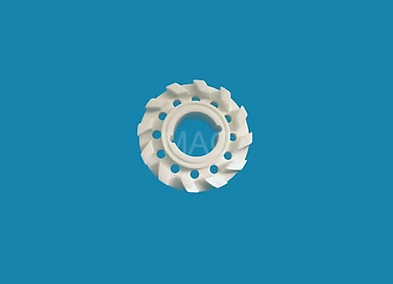
Silicon Nitride (Si₃N₄)
-
The best-balanced material in the range, and the most expensive of the structural options: 700–900 MPa flexural strength, 6–7 MPa·m^0.5 fracture toughness, and the lowest thermal expansion here at 3.2 ×10⁻⁶/K.
-
Its toughness comes from microstructure, not phase transformation. Controlled sintering grows elongated, needle-like β-Si₃N₄ grains that interlock, so a propagating crack has to pull them out or go around them. Unlike zirconia's transformation toughening, this mechanism does not degrade with temperature.
-
Specify it when the part sees rapid thermal cycling, you need a rolling-contact surface, you are handling molten non-ferrous metal, or alumina and zirconia have both already failed.
-
Do not specify it when budget is the binding constraint and a redesign in alumina would work.

Aluminum Nitride (AlN)
-
Solves one problem better than anything else: getting heat out of an electronic package without letting current follow it. At 170–200 W/m·K it conducts heat six times better than alumina while staying an insulator above 10¹⁴ Ω·cm.
-
Its thermal expansion of 4.5 ×10⁻⁶/K is a close match to silicon, which matters enormously for die-attach reliability.
-
It is not a structural material. Flexural strength of 300–350 MPa and fracture toughness of 2.6 MPa·m^0.5 put it at the bottom of this range, and it begins to oxidise in air above about 900 °C.
-
Specify it when power electronics, RF, laser diode or EV inverter thermal management makes heat removal the binding constraint.
-
Do not specify it when the part is structural, or when alumina's 30 W/m·K is sufficient. The cost difference is substantial.

Boron Carbide (B₄C)
-
The third-hardest material known, after diamond and cubic boron nitride, at 2,900–3,300 HV. It is also the lightest ceramic here at 2.52 g/cm³, which is the entire basis of its use in ballistic protection: hardness per unit mass.
-
Everything else about it is a compromise. Fracture toughness of 2.9–3.7 MPa·m^0.5 is the lowest in the range, and it oxidises in air above roughly 800 °C.
-
It is difficult and expensive to densify, and difficult and expensive to machine afterwards.
-
Specify it when abrasive wear or ballistic performance per unit weight is the requirement and nothing else competes: blast nozzles, armour, neutron absorption.
-
Do not specify it when almost anything else will do. Silicon carbide delivers most of the wear performance at a fraction of the cost.
How to Select a Ceramic Material
Start with the failure mode, not the strength number
The question that matters is not "which material is strongest" but "what does this part have to survive, and what happens when it doesn't?"
A ceramic component that fails in a sealed pump is an inconvenience. The same component failing in a semiconductor etch chamber contaminates a wafer lot. In the second case the correct material is the one with the widest margin against the actual failure mode — which is frequently not the strongest, hardest or most expensive option.
Four questions that narrow the field
1. What is the maximum service temperature, and is it steady or cycling? Steady high temperature points to alumina or SiC. Cycling temperature is a different question, governed by thermal expansion and conductivity rather than melting point — and it points to silicon nitride or SiC.
2. Is the load compressive, or is there bending or impact? Every ceramic here handles compression well. Only zirconia and silicon nitride tolerate bending and impact with any margin. If your load is tensile and you cannot redesign it, you may need to reconsider ceramics entirely — see ceramics vs metals vs polymers.
3. Does the part need to insulate, conduct heat, or both? Insulate only → alumina. Insulate and conduct heat → aluminum nitride. Conduct heat, insulation irrelevant → silicon carbide.
4. What is the chemical environment, and at what temperature? Oxides are stable in oxidising conditions and vulnerable to strong alkalis at temperature. Non-oxides resist acids and molten metals well but oxidise in air above their limits. Give us the actual chemistry and temperature; general "corrosion resistance" claims are not specific enough to design against.
Where each material stops
Full property detail sits in the dedicated guides: density of ceramics · hardest ceramics ranked · high-temperature ceramics
Manufacturing and Tolerance Capability
Material selection and manufacturing method are not separable decisions. The forming route determines what geometry is achievable, what it costs, and what tolerance you can hold.
Sintered ceramic shrinks 15–20% during firing, so anything tighter than the figures above requires diamond grinding after fire. We hold ±0.002 mm on ground features where the geometry allows it, with surface finishes to Ra 0.1 µm.
Design guidance that saves money: avoid sharp internal corners, keep wall sections as uniform as you can, tolerance only the features that functionally need it, and send us the drawing before it is finalised. Most cost in a ceramic part is decided at the drawing stage, not the quoting stage.
More detail: ceramic manufacturing processes
Standards and Test Methods
Property --- Standard
Flexural strength --- > ASTM C1161 / ISO 14704
Fracture toughness --- > ASTM C1421
Vickers hardness --- > ASTM C1327
Density and porosity --- > ASTM C373 / ASTM C20
Thermal diffusivity --- > ASTM E1461
Dielectric strengthen --- > ASTM D149
Zirconia surgical implants --- > ISO 13356
Alumina surgical implants --- > ISO 6474
If a supplier quotes a strength figure without naming the test method, the number is not comparable to anything.
Frequently Asked Questions
Which ceramic material is strongest?
By flexural strength, yttria-stabilised zirconia (3Y-TZP) at 900–1,200 MPa. By hardness, boron carbide at 2,900–3,300 HV. By fracture toughness — the property that most often determines whether a part survives — zirconia again, at 8–10 MPa·m^0.5. "Strongest" depends entirely on which failure mode you are designing against.
What is the difference between alumina and zirconia?
Alumina is harder to the touch in service life terms, cheaper, lighter (3.9 vs 6.05 g/cm³), and usable to much higher temperatures (1,700 °C vs ~1,000 °C). Zirconia is roughly three times stronger in bending and two to three times tougher, so it survives impact, handling, and assembly stress that alumina does not. Choose alumina for hot insulating wear parts; choose zirconia for small, highly stressed, handled parts.
Which ceramic material handles the highest temperature?
Among the materials on this page, 99.5% alumina to 1,700 °C in air and sintered silicon carbide to 1,600 °C. Zirconia is limited to about 1,000 °C by phase instability, and the non-oxides AlN and B₄C by oxidation at 900 °C and 800 °C, respectively.
Can technical ceramics be machined after firing?
Yes, but only with diamond tooling, and it is the expensive part of the process. Fired ceramic is machined by grinding, lapping and polishing rather than cutting. Wherever possible, features are formed green and only the critical dimensions are ground after fire.
What tolerances can you hold?
±0.002 mm on ground features where geometry permits, and typically ±0.5% to ±2% as-fired depending on the forming method. Send the drawing and we will tell you which features need grinding and which do not.
Do you supply prototypes as well as production volumes?
Yes — prototype quantities through to production. Send a drawing for review.
If You Need… | Specify | Because |
|---|---|---|
Maximum hardness per unit mass | Boron carbide | 2,900–3,300 HV at 2.52 g/cm³ |
Heat out of an insulator | Aluminum nitride | 170–200 W/m·K, >10¹⁴ Ω·cm |
Rapid thermal cycling | Silicon nitride | 3.2 ×10⁻⁶/K expansion, interlocking β-grains |
Lowest cost insulator, moderate wear | Alumina 96% | Best property-per-dollar in the range |
Highest purity, plasma environments | Alumina 99.5–99.9% | Low glassy phase, low particulate generation |
Impact and handling tolerance | Zirconia 3Y-TZP | 8–10 MPa·m^0.5 toughness, 2–3× the rest |
Toughness at alumina cost | ZTA | ~60% of zirconia's toughness, ~40% of the price |
Abrasion at temperature | Silicon carbide | 2,400–2,800 HV, stable to 1,600 °C |
Method | Best For | Typical As-Fired Tolerance | Volume |
|---|---|---|---|
Extrusion | Tubes, rods, constant sections | ±1% | Medium–high |
Dry pressing | Simple prismatic shapes | ±1% | Medium–high |
Isostatic pressing | Uniform density, larger blanks | ±1% | Low–medium |
Slip casting | Hollow and complex geometry | ±1.5% | Low–medium |
Injection moulding | Small, complex, repeatable parts | ±0.5% | High |
Tape casting | Thin substrates and sheets | ±2% thickness | High |
━━◆━━ Material Selection Guide ━━◆━━
How to Choose Ceramic Material
Choosing the right ceramic material depends on the mechanical, thermal, and electrical demands of your application. Explore the key properties below to compare performance and select the ideal material for your project.

Hardness Levels of Technical Ceramics
The hardness of ceramic materials varies: Zirconia (ZrO2) and Alumina (Al2O3) typically range from 8.8 to 9.0 on the Mohs scale, finding applications in dental implants and cutting tools due to their mechanical properties. Silicon Carbide (SiC) and Silicon Nitride (Si3N4) both exhibit a hardness of 9.0 on the Mohs scale, making them suitable for abrasive materials, refractories, and high-wear applications such as bearings and turbine components. These ceramics play vital roles across industries, offering excellent hardness properties to enhance performance and durability.


