


.jpg)

Silicon Carbide Ceramics: High-End Material Solutions Tailored for Your Field
-
Multiple production methods: pressureless sintering, reaction sintering, 3D printing
-
High hardness and wear resistance for abrasive, high-friction environments
-
Excellent thermal conductivity and thermal shock resistance
-
Strong corrosion resistance across chemical environments
-
Engineering support from design through production
What Is Silicon Carbide Ceramics
Silicon carbide (SiC) ceramic is a synthetic material made by bonding silicon and carbon at high temperature. It's known for extreme hardness (third only to diamond and boron carbide), high thermal conductivity, strong resistance to heat and corrosion, and good thermal shock resistance.
It's made a few different ways — pressureless-sintered, reaction-sintered, or 3D-printed — each with different strength, cost, and shape tradeoffs.
Common uses: semiconductor equipment, mechanical seals, sandblasting nozzles, kiln furniture, armor, and chemical-processing parts.


R&D to Customize Your Silicon Carbide Ceramic Application
_edited.jpg)
Material Research
We evaluate the right SiC process and formulation for your performance requirements.

Engineering Design
We work from your drawings/models to resolve manufacturability issues before tooling begins.
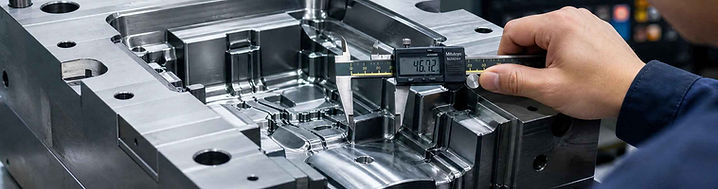
Mold Design
Custom tooling ensures dimensional accuracy and repeatability across production runs.
High Hardness
Resists abrasion and wear
Thermal Conductivity
Efficient heat dissipation
Corrosion Resistance
Stable in harsh chemicals
Temp Stability
Maintains integrity at high heat
Silicon Carbide Ceramics Feature Box
We Can Provide You with Silicon Carbide Materials
Pressureless-Sintered SiC
Sintered without external pressure — suited to complex shapes and larger parts, with a good balance of density, strength, and cost.
Reaction-Sintered SiC
Formed by infiltrating molten silicon into a carbon/SiC preform — good dimensional control, cost-effective for larger or thicker parts.
3D-Printed SiC Ceramics
Enables complex geometries and rapid prototyping not achievable with pressing or casting — ideal for low-volume, custom parts

Customized SiC Material Parameters and Selection
Our Silicon Carbide Product Capabilities
Microstructure-Refined Products
Fine-grain SiC parts for precision applications.
Corrosion-Resistant Products
Parts for chemical processing and harsh-environment equipment.
High-Temperature-Resistant Products
Kiln furniture, furnace components, heat exchangers.
High-Purity Products
For semiconductor and electronics applications.
Wear-Resistant Products
Nozzles, liners, and seal rings for abrasive environments.

Why Choose Microns Advanced Ceramics for Custom Alumina Ceramics?
Microns Advanced Ceramics has 10 years of experience producing and machining Silicon ceramic components for demanding industrial applications. Our team manages every stage from raw material sourcing and forming to sintering, precision grinding, and final inspection — giving customers a single point of accountability for quality and delivery. Our engineering team works directly with customers during design and prototyping to resolve manufacturability issues before full production, reducing lead time and cost on complex geometries.

Application Fields of Silicon Carbide Ceramics

5pm-8pm
DAILY
Semiconductor Manufacturing
SiC components are used in wafer processing equipment for their purity, thermal stability, and plasma-etch resistance.

5pm-8pm
DAILY
Chemical Industry
Corrosion-resistant SiC seals, valves, and pump components withstand aggressive chemical processing.

5pm-8pm
DAILY
Energy
SiC components are used in mechanical seals, bearings, and heat exchangers for power generation equipment.c

5pm-8pm
DAILY
Advanced Manufacturing
SiC's hardness, thermal conductivity, and light weight support emerging engineering applications.

5pm-8pm
DAILY
Seals and Bearings
Used in wear-resistant sealing and bearing materials for chemical pumps and high-pressure fittings.
Frequently Asked Questions
What's the difference between pressureless-sintered and reaction-sintered silicon carbide?
Pressureless-sintered SiC offers higher purity and strength, while reaction-sintered SiC is more cost-effective for large, complex, near-net-shape parts but contains residual free silicon.
Can silicon carbide be 3D printed?
Yes — 3D-printed SiC enables complex geometries and rapid prototyping that traditional pressing or casting can't achieve economically.
Is silicon carbide better than alumina for wear resistance?
SiC generally offers higher hardness and better wear resistance, particularly in abrasive or high-temperature environments, though alumina is more cost-effective for less demanding uses.
What industries use silicon carbide ceramic components?
Semiconductor manufacturing, chemical processing, metallurgy, and energy applications, due to SiC's hardness, thermal conductivity, and corrosion resistance.
How to customize?
Submit drawings, 3D models, or performance requirements for a manufacturability review; we then produce custom Silicon carbide components to your specified shape, dimensions, and tolerances.