


Alumina Ceramic Tubes for Electrical Insulation | Precision Ceramics
- Muhammad Kazim
- Mar 6
- 6 min read

Updated: Jul 26

Alumina Ceramic Tubes for Electrical Insulation
High-purity Alumina Ceramic Tubes (Al₂O₃)tubing engineered for continuous service in high-voltage, high-temperature environments. Dielectric strength up to 20 kV/mm, rated to 1,600 °C — custom-machined to your dimensional specification.
[ REQUEST A QUOTE ] Submit drawings or specifications for a technical review and quotation.
[ DOWNLOAD TECHNICAL DATASHEET ] Grade-specific property data, test standards, and dimensional ranges.
02 / SPECIFICATION SNAPSHOT
Dielectric Strength & Performance Data
The following values represent typical properties for 96% and 99.7% purity alumina grades. All data is referenced against ASTM C373, C1161, and IEC 60672 standards. Grade-specific datasheets are available on request.
Property | Al₂O₃ — 96% Purity | Al₂O₃ — 99.7% Purity | Test Standard |
Density | 3.72 g/cm³ | 3.96 g/cm³ | ASTM C373 |
Vickers Hardness (HV) | 1,450 HV | 1,750 HV | ASTM C1327 |
Flexural Strength (MOR) | 310 MPa | 380 MPa | ASTM C1161 |
Fracture Toughness (K₁c) | 3.5 MPa·m½ | 4.0 MPa·m½ | ASTM C1421 |
Max. Operating Temperature | 1,500 °C | 1,600 °C | — |
Dielectric Strength | 16 kV/mm | 20 kV/mm | IEC 60672 |
Volume Resistivity (25 °C) | >10¹⁴ Ω·cm | >10¹⁵ Ω·cm | ASTM D257 |
Dielectric Constant (1 MHz) | 9.0 | 9.8 | IEC 60250 |
Thermal Conductivity | 24 W/m·K | 30 W/m·K | ASTM E1461 |
Thermal Shock Resistance (ΔT) | 180 °C | 200 °C | MIL-STD-202 |
Water Absorption | 0.00% | 0.00% | ASTM C373 |
Note: Values represent typical tested results. Minimum guaranteed values and tolerance bands are provided in full material certificates issued with each shipment.
03 / MATERIAL OVERVIEW
Temperature Resistance Data & Material Composition
Alumina (Al₂O₃) is a polycrystalline oxide ceramic produced by sintering aluminium oxide powder at temperatures exceeding 1,600 °C, making it a widely used material for high-performance ceramic tube and bushing components in electrical insulation system. Its combination of ionic bonding character, high melting point, and closed-pore microstructure makes it the standard choice for electrical insulation ceramic tubes and alumina dielectric components across demanding industrial sectors.
Chemical Composition & Microstructure
Standard production grades contain 96% to 99.7% Al₂O₃, with trace additions of MgO, SiO₂, and CaO as sintering aids to control grain growth and densification. The resulting fine-grained microstructure (average grain size 2–5 µm) delivers consistent electrical and mechanical properties with minimal batch-to-batch variance. Porosity in 99.7% purity material is typically <0.1%, which is critical for maintaining volume resistivity in high-voltage ceramic tubing applications.
Manufacturing Methods
Alumina ceramic tubes are produced via several processes depending on geometry, wall thickness, and tolerance requirements:
# | Process | Details |
01 | Isostatic Pressing (CIP) | Applied to larger-diameter or thick-walled tubes requiring uniform green density before sintering. Minimises residual stress gradients. |
02 | Dry (Die) Pressing | Cost-effective for short, standardised tube geometries in medium-to-high production volumes with consistent cross-sectional profiles. |
03 | Extrusion | Used for long, thin-walled tube geometries with uniform bore diameter — common in furnace tube and thermocouple protection applications. |
04 | Sintering & Post-Sinter CNC Machining | All tubes are sintered in controlled-atmosphere kilns. Diamond-tool CNC grinding achieves bore and OD tolerances of ±0.01 mm on finished components. |
Available Grades
AL-96 (96% purity, general industrial use) AL-997 (99.7% purity, high-voltage and high-frequency applications) AL-999 (99.9% purity, semiconductor-grade, available on request)
Dimensional Capability & Surface Finish
As-sintered OD tolerances: ±0.3%. Post-machined tolerances: OD/ID ±0.01 mm, length ±0.05 mm. Surface roughness (Ra) after centreless grinding: 0.4–0.8 µm. Lapped inner bore finish available to Ra 0.2 µm for applications requiring low-friction or hermetic sealing. Custom end configurations — flanged, chamfered, threaded — are machined in-house.
04 / APPLICATION EXAMPLES
Common Applications of Alumina Ceramic Tubes

Electrical insulation ceramic tubes and industrial insulation bushings based on Al₂O₃ appear across every sector where concurrent thermal load, electrical stress, and mechanical demand eliminate polymer alternatives.
Power Generation — HV Insulation Bushings & Feed-Throughs
IIn switchgear, busbars, and capacitor banks, alumina tubes function as dielectric spacers and conductor pass-throughs, similar to the applications described in high dielectric strength ceramic insulators used in high-voltage power systems. The material's volume resistivity (>10¹⁵ Ω·cm) and zero moisture absorption prevent creepage even under sustained high-voltage cycling at elevated ambient temperatures.
Industrial Furnaces — Thermocouple Protection & Heating Element Support
Alumina protection tubes shield Type-K, Type-R, and Type-S thermocouples up to 1,600 °C in oxidising and reducing atmospheres, similar to those used in high temperature ceramic tubes for furnaces in industrial thermal processing equipment. Resistance to thermal fatigue and low thermal expansion coefficient (8 × 10⁻⁶/°C) reduce failure frequency vs metallic alternatives in cycling furnace environments.
Semiconductor Fabrication — Process Tube Liners & Wafer Handling
High-purity 99.7% alumina tubes are used as process tube liners and gas distribution components in CVD and diffusion furnaces. Purity is critical — trace metallic contamination from tube material directly affects device yield, making AL-997 and AL-999 grades the specified choice.
Plasma & RF Systems — Feedthrough Components
The stable dielectric constant (9.8 at 1 MHz) and low dielectric loss tangent of high-purity alumina make it a reliable substrate for RF feedthrough tubes and plasma confinement rings in ion implant and plasma etch chambers.
Aerospace & Defence — Actuator Insulation & Sensor Housings
In missile actuation systems, avionics bays, and radar antenna assemblies, alumina tubes provide a combination of structural rigidity, electrical isolation up to rated voltage, and thermal stability across −55 °C to +1,200 °C operational ranges — within a compact, dimensionally stable form factor.
Medical Equipment — X-Ray Tube Envelopes & HV Electrode Isolators
Medical imaging X-ray assemblies require insulating components that combine ultra-low outgassing, freedom from metallic contamination, and ability to withstand intermittent high-voltage transients. 99.7% alumina tubes meet these combined requirements without compromise.
05 / MATERIAL COMPARISON
Alumina vs Polymer Insulators — Which Should You Choose?
The choice between high-voltage ceramic tubing and thermoplastic or thermoset polymer insulators is determined by the combination of operating temperature, voltage class, environment, and service life expectations — not cost alone.
Property / Factor | Alumina Ceramic (99.7%) | Engineering Polymer (PEEK/PTFE) |
Dielectric Strength | 20 kV/mm | 19–24 kV/mm (PTFE) |
Max Operating Temperature | 1,600 °C continuous | 260 °C (PTFE) / 250 °C (PEEK) |
Hardness | 1,750 HV — excellent wear resistance | 60–80 Shore D — susceptible to abrasion |
Moisture Absorption | 0.00% — fully inert | 0.01–0.4% — affects resistivity over time |
Thermal Shock Resistance | Moderate — ΔT 200 °C max | Good (ductile failure mode) |
Chemical Resistance | Excellent (acids, alkalis, solvents) | Good (PTFE broad; PEEK limited to some acids) |
Machinability | Diamond grinding; tighter tolerances | CNC-machinable; faster turnaround |
Outgassing (Vacuum) | Negligible | Measurable — limits vacuum use |
Cost (material basis) | Moderate–high | Low–moderate |
Best Used For | High-temp, HV, vacuum, radiation | Low-temp, cost-sensitive, moderate voltage |
Selection Guidance Polymer insulators are a viable choice when operating temperatures remain below 250 °C and moisture ingress can be controlled. However, when the specification involves continuous temperatures above 300 °C, voltage classes exceeding 10 kV, vacuum environments, or field service lives exceeding 10 years under thermal cycling, alumina ceramic tubes deliver measurably longer mean time between failure (MTBF) and should be considered the primary candidate material. |
06 / CUSTOM DIMENSIONS & MACHINING
Manufacturing Capability & Quality Control
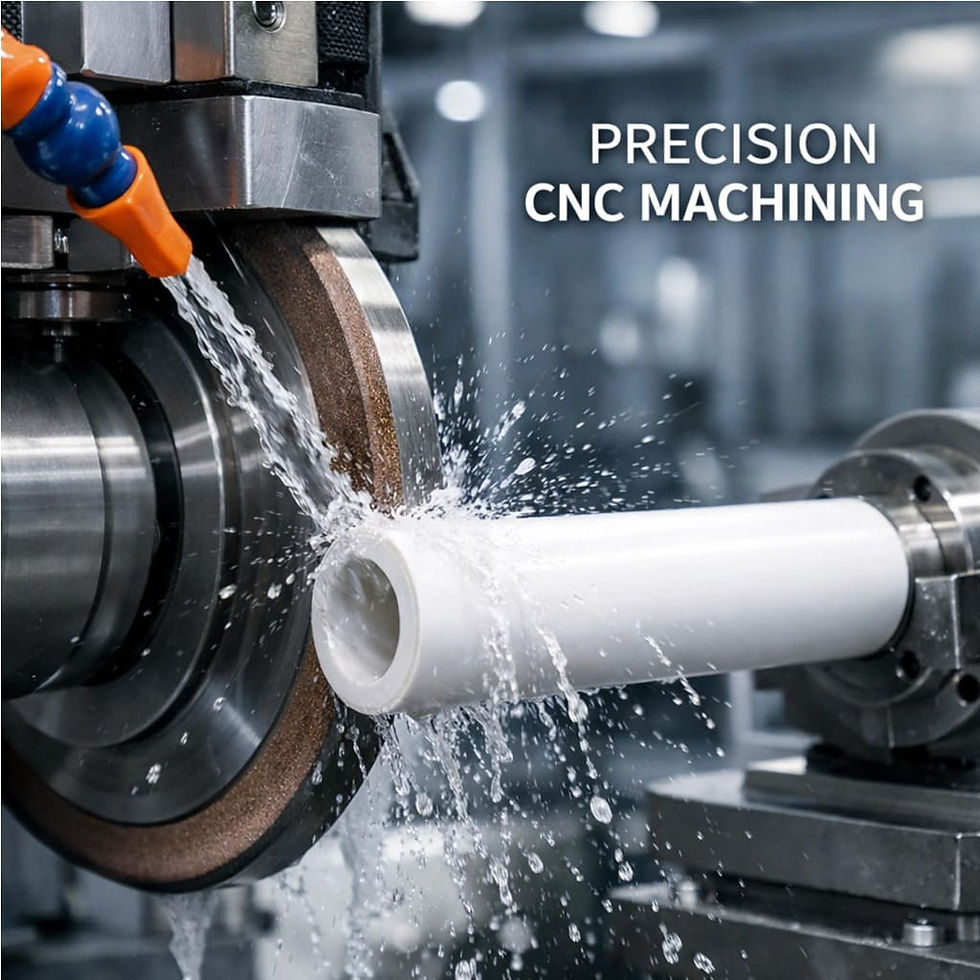
All alumina ceramic tubes are manufactured and finished in-house — from raw powder batching through sintering and final CNC machining — with no outsourcing of critical manufacturing steps.
In-House Production Range
Standard tube production range: OD 3 mm to 220 mm, wall thickness 0.5 mm to 30 mm, lengths to 1,200 mm. Non-standard profiles — step bores, flanged ends, slotted sidewalls, tapered sections — are available as custom-machined components from post-sinter blanks. Minimum order quantities for custom geometries start at single prototype quantities.
Inspection & Quality Assurance
Each production batch undergoes dimensional verification using CMM (Coordinate Measuring Machine) inspection with full report documentation. Critical electrical insulation components are subject to high-voltage withstand testing per IEC 60672 before shipment. Additional non-destructive evaluation — dye penetrant inspection, density verification by Archimedes method, and microstructural SEM review — is available for aerospace and medical applications on request.
Process Certifications & Documentation
Manufacturing operates under ISO 9001:2015 quality management. Material certificates, first-article inspection reports (FAIR), and batch-traceable documentation are provided with every shipment. AS9100 compliance documentation is available for aerospace supply chain requirements.
Lead Times
• Standard stocked tube dimensions: 2–5 working days
• Custom machined components from existing blanks: 7–15 working days
• Full custom geometry from green forming: 4–8 weeks depending on complexity
• Expedited production scheduling available for qualification or emergency replacement orders
07 / CAPABILITY SIGNALS
Manufacturing Authority
Factual production capability summary.
Metric | Capability | Notes |
20+ Years | Manufacturing technical ceramic components for industrial OEMs worldwide |
|
| ||
ISO 9001:2015 | Full batch traceability and documented quality management system |
|
±0.01 mm | Post-machined dimensional tolerance capability on OD/ID/length |
|
6 Sectors | Power, semiconductor, aerospace, medical, industrial furnace, defence |
|
1:1 Support | Direct application engineering support from ceramic materials engineers |
|
08 / REQUEST DATASHEET / RFQ
Need Precision Alumina Components? Request a Technical Consultation.
Submit your drawing or specification and receive a dimensionally reviewed quote from a ceramic materials engineer. We work from CAD files, PDF drawings, or verbal specifications.
• STEP, IGES, DXF, DWG, and PDF drawings accepted
• Prototype to production volume — single pieces welcome
• Grade selection and design-for-manufacturability advice included at no charge
• First response within 1 working day for standard enquiries
• Material certificates and test reports issued with all shipments
How to Submit a Technical Enquiry Email: info@microns-ceramics.com Include: component description, grade preference, OD/ID/length, tolerance requirement, quantity, and delivery requirement. Prototypes manufactured. No minimum order required for qualification samples. |


Comments