


Ceramic vs Tungsten Carbide: Which Wins for Wear Parts?


Procurement teams sourcing wear-resistant components — seal faces, nozzles, valve trim, guides, bushings — regularly default to tungsten carbide because it's familiar. But in abrasive, corrosive, or high-temperature service, that default can shorten part life and inflate total cost of ownership. This post breaks down where technical ceramics outperform tungsten carbide, where carbide still wins, and how to make the call on your next wear-part spec.
Need to compare ceramic and tungsten carbide for a specific wear part?Share your drawing or application details with MAC's engineering team to receive material recommendations, manufacturability feedback, and a custom quotation.
What "Ceramic" and "Tungsten Carbide" Actually Mean in Wear Applications
"Tungsten carbide" in wear parts is almost never pure WC — it's a cermet: WC grains (typically 80–94% by weight) sintered in a metallic binder, usually cobalt (Co) or nickel (Ni), at 6–15% binder content. The binder is what gives carbide its toughness, but it's also its weak point: cobalt leaches out under acid attack, galvanic corrosion, and high-velocity erosion, exposing WC grains that then pull loose.
Technical ceramics used for wear parts are monolithic, binder-free polycrystalline materials — no metallic phase to corrode. The main families MAC works with are:
Alumina (Al₂O₃) — 90–99.8% purity grades, the workhorse ceramic for general wear and electrical insulation
Zirconia (Y-TZP, yttria-stabilized) — higher toughness, used where impact or thermal shock risk is elevated
Silicon carbide (SiC) — reaction-bonded or sintered, for high-hardness/high-temperature erosive service
Silicon nitride (Si₃N₄) — best balance of hardness and fracture toughness among structural ceramics, common in bearing and pump components
Because there's no binder phase, ceramics don't suffer the same corrosion-driven grain pullout mechanism that limits carbide life in wet chemical or acidic environments.
Key Properties and Specs

Numbers vary by grade and supplier process (grain size, sintering method, binder chemistry), so treat these as representative ranges rather than a single manufacturer's certified data. Confirm exact values against the specific grade's material data sheet before specifying.
Property | Alumina (99.5%) | Zirconia (Y-TZP) | Silicon Carbide | Silicon Nitride | Tungsten Carbide (WC-6Co) |
Hardness | ~1500–1600 HV | ~1200–1300 HV | ~2400–2800 HV | ~1400–1600 HV | ~1600–1800 HV (89–92 HRA) [VERIFY grade-specific] |
Density (g/cm³) | ~3.9 | ~6.0 | ~3.1 | ~3.2 | ~14.5–15.0 |
Fracture toughness (MPa·m^½) | ~3.5–4.5 | ~7–10 | ~3.5–4.5 | ~6–8 | ~10–20 [VERIFY grade-specific] |
Max continuous use temp | ~1700°C (inert) | ~1000–1100°C | ~1600°C | ~1200°C | ~500–600°C in air before oxidation onset [VERIFY] |
Corrosion resistance (acid/chemical) | Good | Good | Excellent | Excellent | Poor–moderate (binder attack) |
Electrical behavior | Insulator | Insulator | Semiconductor (grade-dependent) | Insulator | Conductor |
Two things drive most selection decisions:
Hardness vs toughness trade-off: Ceramics generally out-hard carbide but trail it on fracture toughness, meaning they resist abrasive wear extremely well but are less forgiving of impact loading or edge chipping if the design isn't detailed correctly.
Environment: In dry abrasive wear (particulate flow, dry powder handling), carbide and SiC/Si₃N₄ ceramics perform comparably. In wet, acidic, or high-temperature service, ceramics pull ahead because there's no binder to corrode and no oxidation limit at typical process temperatures.
Standard quality references worth specifying on drawings: ASTM C1327 (compressive strength, advanced ceramics), ASTM C1421 (fracture toughness test methods), ASTM B611 (abrasion resistance of cemented carbides), and supplier quality system certification to ISO 9001.
Industrial Applications by Material
Semiconductor processing — Alumina and machinable ceramics (e.g., glass-ceramic insulators) dominate for their electrical insulation, purity, and dimensional stability under thermal cycling in wafer handling, chuck components, and process chamber parts. Tungsten carbide's conductivity and metallic contamination risk generally rule it out in cleanroom process zones.
EV / battery manufacturing — Zirconia and alumina components show up in electrode slitting, calendaring rollers, and battery slurry-handling equipment where abrasive particulate wear is constant and any metallic contamination from tool wear can compromise cell chemistry. Ceramic's non-conductive, non-magnetic, contamination-free wear surface is often a hard requirement, not a preference.
Oil & gas — Both materials appear here. Tungsten carbide remains standard for many downhole tools and drill components where toughness under impact matters more than chemical resistance. Silicon carbide and zirconia move in for valve seats, chokes, and seal faces in produced-water and sour-gas service where H₂S and chlorides attack cobalt binders.
Chemical processing — Silicon carbide and alumina pump seal faces, nozzles, and ceramic valve components are the default in acidic or caustic media handling, since carbide's binder corrosion becomes a recurring failure mode in these services.
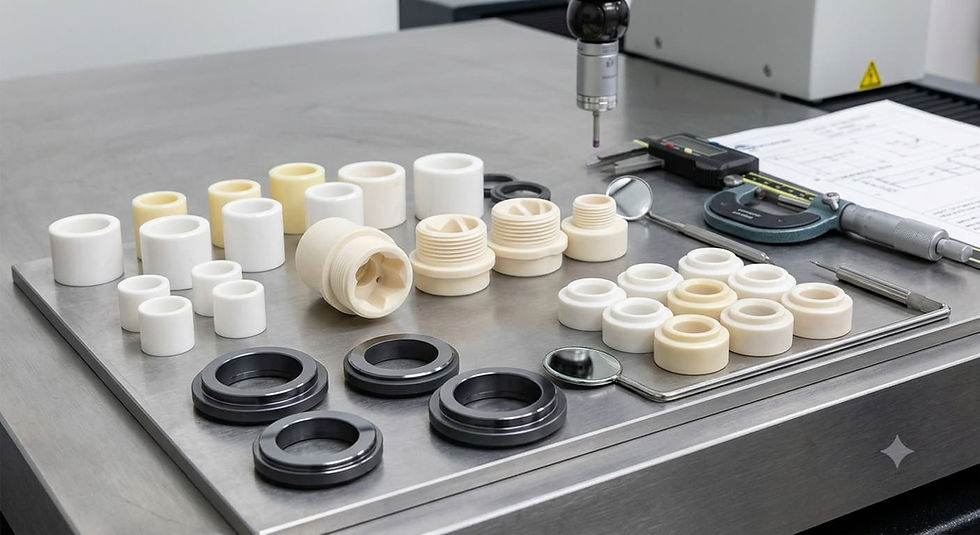
General industrial equipment — Guides, bushings, wear plates, and thread/wire guides in textile and metal-forming equipment often use alumina or zirconia for its combination of hardness, low friction, and long service life without lubrication.
How to Select and Compare Suppliers

When evaluating ceramic vs. carbide — or comparing ceramic suppliers against each other — procurement and engineering teams should be checking:
Grade-specific data, not generic material claims. Ask for the actual data sheet for the grade being quoted, not a generic "alumina" spec.
Achievable tolerances. Ground and lapped ceramic components can commonly hold tolerances in the ±0.0005 in. (±0.0127 mm) range on critical dimensions and single-digit microinch surface finishes on lapped faces — confirm against your part geometry, since tolerance capability varies with feature type and size. [VERIFY current shop capability for specific geometries]
Tight tolerances and surface finish requirements can significantly influence material selection and manufacturing cost. If you're specifying a custom seal face, valve component, nozzle, or bushing, MAC's engineers can review your drawing and recommend the most suitable ceramic grade based on your operating environment and dimensional requirements.
Fracture toughness and Vickers indentation hardness testing (ASTM C1327) and QA documentation, not just generic numbers on a sales sheet.
Lead time and domestic capacity. Custom ceramic components typically carry longer lead times than off-the-shelf carbide inserts; confirm prototype-to-production timelines and whether tooling is domestic or overseas.
Total cost of ownership, not unit price — factor in mean time between failures, unplanned downtime, and contamination risk, not just piece cost.
Certifications. ISO 9001 quality system certification at minimum; AS9100 or ITAR registration if the end application requires it.
Why This Decision Matters
A wear part that fails prematurely in a semiconductor tool or EV battery line doesn't just cost the price of the component — it costs unplanned downtime, contamination events, and in regulated or high-purity processes, potential scrap of downstream product. Getting the material call right the first time, backed by real grade data and dimensional capability rather than a generic material comparison, is often the difference between a six-month replacement cycle and a multi-year one.
Microns Advanced Ceramics manufactures precision technical ceramic components — alumina, zirconia, silicon carbide, and silicon nitride — for semiconductor, EV/battery, oil & gas, chemical processing, and industrial equipment OEMs from its Hayward, California facility, operating under an ISO 9001 quality system.
Ready to Compare Materials for Your Application?
Selecting between tungsten carbide and advanced ceramics requires more than comparing hardness values—it requires evaluating wear mechanisms, operating conditions, manufacturability, and long-term cost of ownership. MAC's engineering team works directly with OEMs and industrial manufacturers to recommend the right ceramic material, review part drawings, and support projects from prototype through production.
Looking for more information about our manufacturing capabilities and engineered ceramic solutions? Visit our Custom Technical Ceramic Components page to explore available materials, precision machining capabilities, and custom OEM manufacturing options.
Key Takeaways
Tungsten carbide's cobalt binder makes it vulnerable to corrosion and erosion in acidic, chemical, or high-temperature environments — ceramics avoid this failure mode entirely since they're binder-free.
Ceramics generally offer higher hardness and better temperature and corrosion resistance; tungsten carbide generally offers higher fracture toughness for impact-heavy service.
Material choice should be driven by environment (dry abrasion vs. wet/chemical/thermal) and contamination sensitivity (semiconductor and battery applications often require non-conductive, non-metallic wear surfaces).
Always request grade-specific data sheets and independent test data (ASTM C1327, C1421, B611) rather than relying on generic material comparisons.
Confirm supplier tolerance capability, lead time, and ISO 9001 (or higher) certification before finalizing a wear-part material decision.


Comments