


Navigating BAA and DFARS Compliance in Advanced Ceramic Sourcing


If you've ever had a shipment held up at final inspection because a certificate of origin didn't match the paperwork trail, you already know what's at stake here. For procurement officers and supply chain engineers sourcing components for Department of Defense (DoD) programs, a single missing traceability document can stall a production line, trigger a contract compliance review, or worse — put an entire award at risk during audit.
This is the reality of Buy American Act (BAA) and DFARS compliance for ceramic component sourcing: the regulatory bar is high, the paperwork is unforgiving, and the cost of getting it wrong is measured in blown schedules and damaged contractor relationships. The good news is that advanced technical ceramics — alumina, zirconia, silicon carbide, and silicon nitride — sit in a different regulatory lane than metals, and understanding exactly where that lane runs is the first step to sourcing with confidence.
Quick Answer: Advanced technical ceramics are not classified as "specialty metals" and therefore fall outside DFARS 252.225-7008's specialty metals restriction. However, ceramic components used in DoD end products must still satisfy Buy American Act domestic content rules under FAR Part 25 — meaning the component's origin, manufacturing location, and cost breakdown still require full documentation and traceability to pass a federal audit.
Below, we break down the technical distinction between these two regulatory frameworks, what a clean audit trail actually looks like for ceramic raw materials, and why a domestically engineered supply chain is quickly becoming non-negotiable for defense contractors.
The Technical Distinction — Ceramics under DFARS vs. BAA
One of the most common points of confusion in defense procurement is assuming that any restriction applying to metals automatically applies to ceramics. It doesn't — but that doesn't mean ceramics get a free pass.
Do advanced ceramics fall under DFARS specialty metals restrictions?
No. DFARS 252.225-7008, the Restriction on Acquisition of Specialty Metals clause, specifically governs materials such as steel with defined alloy content thresholds, titanium and titanium alloys, and nickel-iron-cobalt base alloys containing more than 10% other alloying metals. Advanced technical ceramics — alumina (Al2O3Al_2O_3 Al2O3), zirconia (ZrO₂), silicon carbide (SiC), and silicon nitride (Si3N4Si_3N_4 Si3N4) — are chemically and structurally distinct from these metallic compositions and are not captured under this specialty metals definition. This means ceramic components are generally exempt from the specialty metals domestic-melt and manufacture requirements that create so much friction for metal parts suppliers.
If ceramics aren't specialty metals, why do they still need compliance documentation?
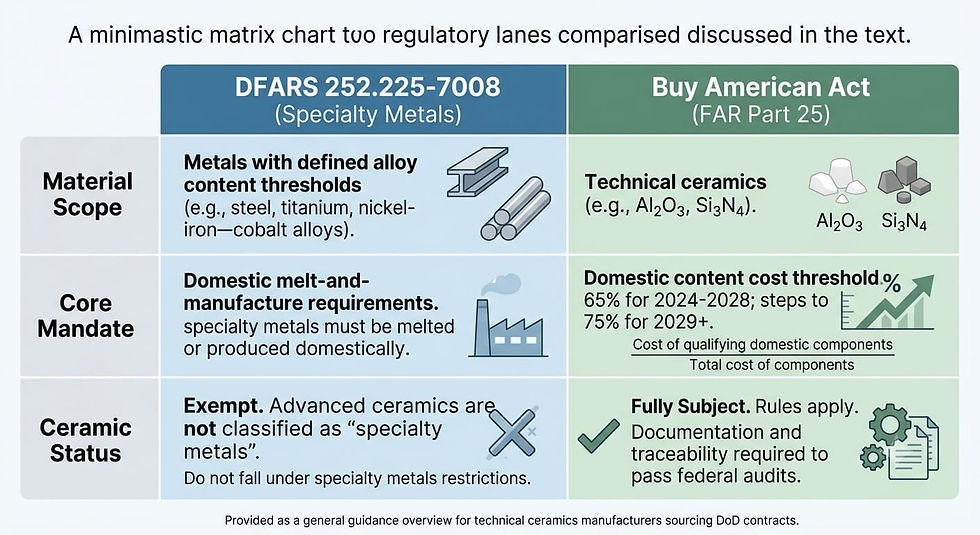
Because DFARS specialty metals exemption does not equal BAA exemption. Ceramic components integrated into a DoD end product are still subject to the Buy American Act, administered through FAR Part 25, which governs domestic content requirements for essentially all federal supply contracts not otherwise covered by a trade agreement waiver. The specialty metals clause and the BAA are two separate compliance frameworks, and a component can clear one while still being fully bound by the other.
Data-Driven Compliance Fact: Under the FAR Council's final rule implementing Executive Order 14005, the domestic content threshold for a manufactured end product to qualify as a "domestic end product" under the BAA is currently 65% for items delivered in calendar years 2024 through 2028, stepping up to 75% for items delivered in calendar year 2029 and beyond. This threshold is calculated based on the cost of qualifying domestic (or qualifying-country) components relative to the total cost of all components in the end product — meaning every ceramic sub-component's cost basis and country of origin needs to be documented and defensible.
For procurement teams, this means the real compliance question isn't "does this ceramic component trigger specialty metals restrictions?" — it's "can I prove, with cost and origin documentation, that this component contributes to the 65% (soon 75%) domestic content threshold my end product needs to hit?"
De-Risking Sourcing with Material Traceability
Passing a DoD compliance audit isn't about intent — it's about paperwork that holds up under scrutiny. This is where ceramic sourcing gets technically demanding, because raw material traceability for advanced ceramics is more complex than for standardized metal stock.
What documentation does a procurement officer need for ceramic material traceability?
At minimum, a defensible audit trail for alumina, zirconia, silicon carbide, or silicon nitride components should include:
Certified Material Composition Reports — confirming exact chemical composition and purity grade (e.g., 96% vs. 99.5% alumina), since performance specifications and cost basis both hinge on purity level.
Country-of-Origin Documentation — tracing the raw ceramic powder or feedstock back through processing and sintering, not just the final machining location.
Dimensional and Mechanical Inspection Reports — including density, hardness, flexural strength, and thermal shock resistance data tied to the specific production lot.
Cost Breakdown by Component — itemized enough to support the BAA domestic content percentage calculation at the end-product level.
Lot-Level Traceability Records — linking a finished, machined ceramic part back to its specific raw material batch, furnace run, and inspection results.
Why does material certification matter more for ceramics than for metals?
Because technical ceramics are processed materials — powder is formed, pressed, sintered, and often ground or lapped to final tolerance — the "raw material" and "manufacturing" stages are harder to separate than with metal bar stock or plate. An auditor reviewing a metal part can often trace origin through a single mill certification. A ceramic component's origin story runs through powder synthesis, forming, firing, and precision machining — each of which needs its own documented link in the chain. A gap anywhere in that sequence is a gap an auditor will find.
This is precisely where sourcing decisions either protect a contract or expose it. A supplier who can hand over a single, complete traceability package — from powder lot to finished, inspected part — turns what should be the hardest part of a DoD audit into a non-issue.
Why a Domestic Engineering Partner Is Mandatory
Compliance documentation only works if the underlying engineering decisions were made with BAA and DFARS requirements in mind from the start — not retrofitted after the fact. This is where sourcing strategy and engineering strategy converge.
How does domestic engineering oversight reduce compliance risk?
When custom ceramic components are designed, material-selected, and specified by a U.S.-based engineering team, compliance isn't a downstream checkbox — it's built into the part from the first conversation. At Microns Advanced Ceramics (MAC), our U.S.-based engineers work directly with procurement and design teams to:
Align material selection (alumina, zirconia, silicon carbide, or silicon nitride) with both the performance envelope of the application and the documentation requirements of the contract.
Maintain full material traceability from raw powder lot through final precision machining, so every component ships with an inspection report that stands up to audit scrutiny.
Provide direct, real-time technical communication — no time-zone lag, no translation gaps, no ambiguity in spec interpretation — which matters enormously when a single dimensional tolerance or material grade decision affects contract compliance.
Support direct factory-sales pricing, cutting out distributor markups while keeping full visibility into cost breakdowns procurement teams need for BAA domestic content calculations.
What does "100% guaranteed quality" mean in a federal sourcing context?
It means every ceramic component MAC ships is backed by detailed inspection reporting and complete material certification as standard practice — not an added service tier. For a defense contractor facing a DCMA or agency compliance review, that translates directly into an audit that clears cleanly, on the first pass, without a scramble to backfill missing documentation.
Compliance Doesn't Have to Stall Production
Sourcing advanced ceramics for a DoD program means operating at the intersection of two regulatory frameworks — DFARS specialty metals rules that ceramics largely sidestep, and Buy American Act domestic content thresholds that ceramics remain fully subject to. The contractors who move fastest through federal audits aren't the ones who found a loophole — they're the ones who partnered with a supplier whose engineering, documentation, and manufacturing all originate on U.S. soil, built for traceability from the first powder lot to the final inspection report.
Microns Advanced Ceramics combines a U.S.-based engineering team, full material traceability, and direct factory-sales pricing to give defense contractors and procurement teams a ceramic sourcing partner built for compliance-ready delivery — not compliance-related delays.
Ready to de-risk your next procurement cycle? Submit your blueprints and specifications today to Request an RFQ from Microns Advanced Ceramics and get a compliance-ready quote backed by full documentation, from raw material to finished part.
Frequently Asked Questions
Are alumina, zirconia, silicon carbide, and silicon nitride considered "specialty metals" under DFARS?
NO.DFARS 252.225-7008 applies to specific metallic compositions — steel, titanium and titanium alloys, and certain nickel-iron-cobalt alloys. Advanced technical ceramics are structurally and chemically distinct from these materials, so they fall outside this specific restriction.
Does that mean ceramic components are exempt from Buy American Act requirements?
NO.DFARS specialty metals exemption is separate from BAA compliance. Ceramic components in a DoD end product are still subject to FAR Part 25 domestic content rules, so origin, manufacturing location, and cost data still need to be documented and defensible.
What is the current BAA domestic content threshold for a manufactured end product?
Under the FAR Council's rule implementing Executive Order 14005, the threshold is 65% for items delivered from calendar year 2024 through 2028, rising to 75% starting in calendar year 2029.
What documentation should I request from a ceramic component supplier for audit purposes?
At minimum: certified material composition reports, country-of-origin documentation from powder through sintering, dimensional and mechanical inspection reports, an itemized cost breakdown by component, and lot-level traceability records linking the finished part back to its raw material batch.
Why is traceability harder to verify for ceramics than for metals?
Ceramic parts go through powder synthesis, forming, sintering, and precision machining — each stage needs its own documented link. Metal parts can often be traced through a single mill certification, but ceramics don't have an equivalent single-document shortcut.
Can MAC provide full material traceability with each order?
Yes. Every component ships with detailed inspection reporting and material certification as standard practice, covering raw powder lot through final machining — no added service tier required.
How do I get a compliance-ready quote for a custom ceramic component? [Request an RFQ] with your blueprints and specifications, and MAC's U.S.-based engineering team will work directly with you on material selection, tolerances, and the documentation needed to support your BAA domestic content calculation.


Comments