


Fluid Control Ceramic Components Manufacturer | OEM Precision
- Muhammad Kazim
- Mar 5
- 7 min read


Fluid Control Ceramic Components Manufacturer
Engineered ceramic parts for demanding flow environments — precision-manufactured to OEM tolerances with verified dimensional repeatability.
❓Can We Manufacture Your Design?
✔ Custom Dimensions ✔ Tight Tolerances ✔ Prototype & Production Quantities ✔ Alumina, Zirconia, Silicon Nitride & Advanced Ceramics ✔ Engineering Review Available
Technical Performance Data
The table below provides reference-grade mechanical and thermal data for the primary grades used in fluid control ceramic components. All values reflect sintered part properties under standard test conditions.
Property | Al₂O₃ 96% Grade | Al₂O₃ 99.7% Grade | ZrO₂ (Y-TZP) |
Density (g/cm³) | 3.72 | 3.96 | 6.05 |
Hardness (HV10) | 1,400 | 1,750 | 1,250 |
Flexural Strength (MPa) | 330 | 400 | 900–1,200 |
Fracture Toughness KIC (MPa·m½) | 3.5 | 3.8 | 7.0–10.0 |
Max. Operating Temperature (°C) | 1,500 | 1,600 | 850 (in wet sealing) |
Dielectric Strength (kV/mm) | 15 | 17 | 9 |
Thermal Shock Resistance (ΔT, °C) | 200 | 200 | 350 |
Surface Roughness Ra (µm, finished) | ≤ 0.4 | ≤ 0.2 | ≤ 0.1 |
Dimensional Tolerance (standard) | ± 0.02 mm | ± 0.01 mm | ± 0.01 mm |
Ceramic Materials for Flow Systems
Chemical Composition & Microstructure
Alumina (Al₂O₃) grades at 96 % and 99.7 % purity constitute the core material platform for most pump ceramic components and ceramic valve seats. The 96 % grade contains controlled silica and magnesia additions that promote liquid-phase sintering and suppress grain growth, resulting in a fine-grained microstructure averaging 2–4 µm that delivers reliable hardness and abrasion resistance in high-cycle valve duty. The 99.7 % grade eliminates glassy grain-boundary phases, yielding superior chemical inertness in aggressive media — critical for wear resistant ceramic seals exposed to acids, alkalis, and chlorinated process fluids.
Yttria-stabilised tetragonal zirconia polycrystal (Y-TZP) is specified where impact resilience and thermal shock resistance take priority alongside wear resistance. Its transformation-toughening mechanism suppresses crack propagation under cyclic hydraulic loading, making it the preferred grade for high-pressure valve seats subject to water hammer events.
Available Grades
• Al₂O₃ 96 % — cost-optimised workhorse material for fluid control ceramics used in pumps, valve seats, and metering systems.
• Al₂O₃ 99.7 % — maximum chemical purity for semiconductor, pharmaceutical, and food-grade duty
• ZrO₂ Y-TZP (3 mol %) — high toughness / thermal shock grade for dynamic sealing and high-pressure drop service
• ZrO₂ / Al₂O₃ composites (ZTA) — balanced hardness-toughness for erosive slurry duty
Manufacturing Methods of Fluid Control Ceramic Components
All fluid control ceramic components are formed through one of three primary consolidation routes, selected based on part geometry, tolerances, and production volume:
• Isostatic pressing (CIP/WIP) — preferred for thick-section parts, piston liners, and cylindrical slugs; produces uniform density gradients across complex cross-sections.
• Dry uniaxial pressing — standard for flat ceramic valve seats and disc geometries below 120 mm diameter; enables high-volume throughput with consistent green density.
• Ceramic injection moulding (CIM) — selected for complex net-shape geometries such as ported valve bodies and multi-channel flow directors where post-sinter machining would be cost-prohibitive.
Sintering is performed in controlled-atmosphere box kilns and tunnel kilns calibrated to ± 5 °C uniformity. Post-sinter CNC grinding and lapping achieve final dimensional tolerances of ± 0.01 mm on sealing faces and bore diameters. Cylindrical grinding, centreless grinding, and surface lapping are all performed in-house.
These manufacturing methods allow engineers to achieve the tight tolerances required for ceramic flow control components used in precision pump assemblies and industrial metering systems.
Surface Finishing Options
• As-sintered (Ra 0.8–1.6 µm) — for non-sealing faces and structural bodies
• Ground (Ra 0.4 µm) — standard sealing faces
• Lapped / polished (Ra ≤ 0.1 µm) — precision ceramic valve seats, rotary disc seals, and flow metering orifices
• Honed bore finish — pump liners and check-valve seats requiring matched metal clearances
Applications in Pumps & Valves

Oil & Gas / Upstream Processing
Ceramic valve components such as valve seats and trim parts in wellhead choke valves, chemical injection systems, and produced-water handling must withstand sand-laden flows at high differential pressures.
Alumina 96 % seats with matched tungsten carbide balls deliver service lives 8–12× longer than 316L stainless in these erosive conditions, reducing intervention frequency on subsea and remote installations.
Chemical Process Industry
Industrial flow control ceramics fabricated from 99.7 % Al₂O₃ are specified for metering pumps, dosing valves, and chemical transfer lines handling concentrated acids, caustic solutions, and oxidising agents. The near-zero porosity of sintered high-purity alumina prevents media absorption and ion contamination — a requirement in pharmaceutical API synthesis and semiconductor-grade chemical supply.
Water & Wastewater Treatment
Wear resistant ceramic seals and disc assemblies extend maintenance intervals in variable-frequency-drive centrifugal pumps handling grit-laden raw water and abrasive filter backwash. Y-TZP disc seals for quarter-turn ball valves in waterworks applications demonstrate dimensional stability to < 0.005 mm after 500,000 actuation cycles.
Food, Beverage & Sanitary Processing
99.7 % alumina pump ceramic components satisfy FDA 21 CFR and EU 1935/2004 food-contact compliance. Non-porous, non-reactive sealing surfaces inhibit bacterial adhesion, while resistance to CIP/SIP cleaning agents (NaOH, HNO₃, steam) eliminates the degradation issues common with PTFE and elastomer seals in high-temperature pasteurisation circuits.
Power Generation
Ceramic plunger liners and packing rings in boiler feed and descaling pump systems tolerate continuous service at 200 °C in high-pressure feedwater service. Alumina's low thermal expansion coefficient (8 × 10⁻⁶ /°C) reduces differential expansion stresses against steel housings compared with carbide alternatives, simplifying installation design.
Hydraulics & Pneumatics
Precision-lapped ceramic spool valve inserts achieve the tight radial clearances (3–8 µm) required for proportional control valves in industrial hydraulic systems. Surface hardness above 1,400 HV prevents the micro-welding and fretting wear that limits hardened steel spools in high-cycle servo applications.
Corrosion & Abrasion Resistance
Alumina (Al₂O₃) vs Zirconia (ZrO₂) — Which Should You Specify?
Material selection for fluid control ceramic components ultimately depends on the dominant failure mode in the application. Use the comparison below as a starting framework before discussing requirements with our engineering team.
Feature | Alumina Al₂O₃ (96–99.7 %) | Zirconia ZrO₂ (Y-TZP) |
Hardness (HV10) | 1,400–1,750 | 1,200–1,300 |
Fracture Toughness KIC (MPa·m½) | 3.5–3.8 | 7.0–10.0 |
Flexural Strength (MPa) | 330–400 | 900–1,200 |
Thermal Shock Resistance (ΔT °C) | 200 | 350 |
Max. Use Temperature | Up to 1,600 °C | ≤ 850 °C (wet sealing duty) |
Chemical Resistance (broad spectrum) | Excellent | Good (avoid strong HF / alkali) |
Wear Resistance (abrasive slurry) | High | Very High |
Material Cost Index | Low–Moderate | Moderate–High |
Best Applied To | Valve seats, pump liners, metering orifices, chemical duty | High-pressure seals, dynamic discs, impact-prone valve trim |
Alumina is the default specification for most industrial flow control ceramics where chemical resistance and abrasion resistance are the primary performance drivers. Zirconia becomes the preferred selection where cyclic hydraulic loading, water hammer risk, or high-pressure drop across a restricted orifice creates fracture-critical conditions that exceed alumina's toughness threshold. In slurry applications combining both abrasion and impact, a ZTA composite (zirconia-toughened alumina) typically offers the best cost-performance balance. Our applications engineering team can model the dominant failure mode for your specific duty and recommend the appropriate grade.
Precision Production Process
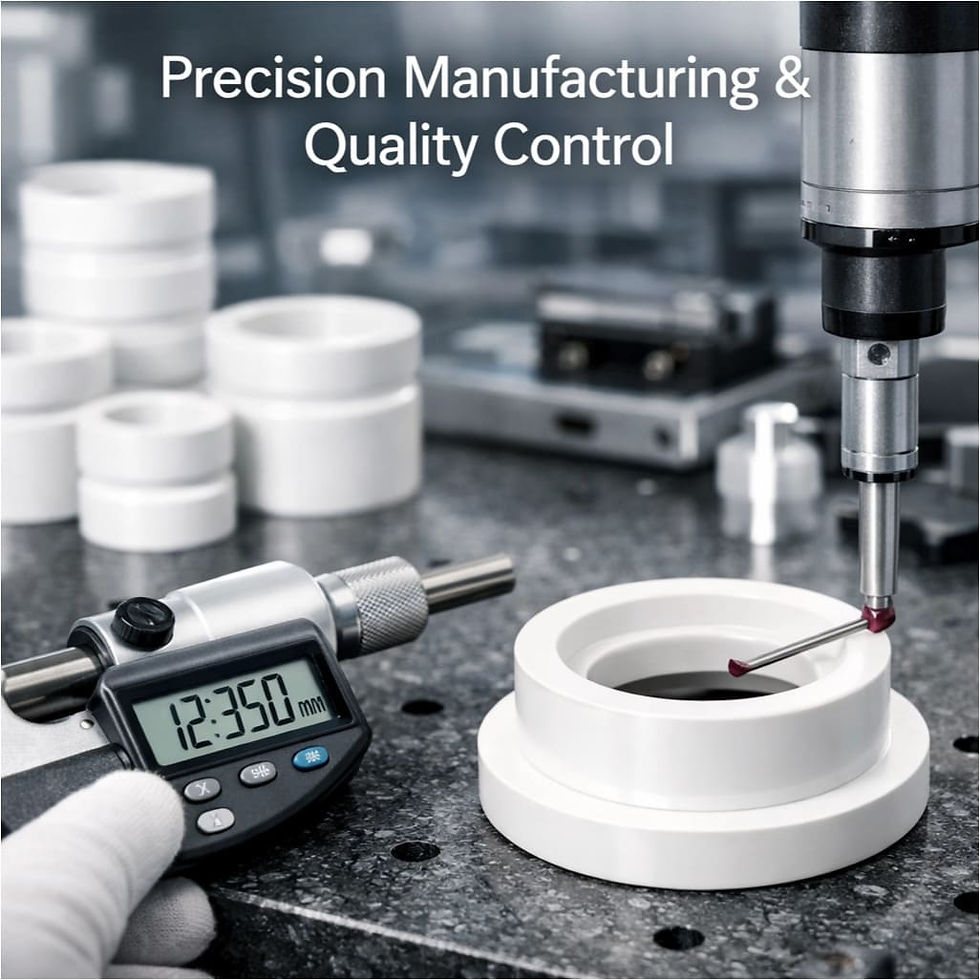
In-House Production Capability
All stages of the manufacturing sequence — powder formulation, forming, binder removal, sintering, and precision machining — are performed on a single integrated site. This eliminates inter-supplier transport risk, maintains full traceability from raw powder batch to finished component, and allows engineering changes to be implemented without supply-chain renegotiation.
Quality Control & Inspection
• Incoming raw material certification: XRF composition verification and BET surface area analysis on every powder lot
• Green density verification by mass/volume measurement post-pressing; Cp ≥ 1.33 required for sealing-face parts
• Sintering process control: thermocouple calibration per IEC 60584, shrinkage tracking, and witness sample programme per batch
• Dimensional inspection: Mitutoyo CMM (± 0.002 mm system accuracy), surface profilometry, roundness measurement to ASME B89.3.1
• Non-destructive evaluation: dye-penetrant inspection for surface cracks on all pressure-bearing components
• Hardness verification: Vickers indentation (HV10) on 100 % of finished ceramic valve seats and wear rings
• Material certifications: C of C with material grade, lot number, key mechanical properties, and dimensional report issued with every shipment
Batch & Custom Manufacturing
Standard catalogue geometries — seat discs, plunger tips, orifice plates, and valve balls — are maintained in semi-finished slug inventory for accelerated lead times of 2–4 weeks. Custom OEM geometries manufactured from customer-supplied drawings carry standard lead times of 4–8 weeks from drawing approval, depending on complexity and forming method. Prototype quantities from single-piece samples are supported; NRE tooling costs apply only where dedicated pressing tooling is required.
Certifications & Standards
• ISO 9001:2015 quality management system — design, manufacture, and supply of advanced technical ceramics
• RoHS and REACH compliance documentation available on request
• Material test reports traceable to ASTM C1161 (flexural strength) and ASTM C1421 (fracture toughness) on request
• Dimensional reports formatted to customer PPAP or AS9102 first-article requirements upon request
Manufacturing Authority & Engineering Support
Our facility has manufactured precision ceramic components for fluid control systems for over 25 years, supplying OEM engineering programmes and MRO replacement parts across six continents. The installed capability encompasses the full range of technical ceramic grades from standard alumina through zirconia, silicon carbide, and silicon nitride.
Manufacturing experience | 25+ years in precision technical ceramics |
Export markets | Europe, North America, Middle East, Southeast Asia, Australia |
Industries served | Oil & gas, chemical processing, water treatment, food & beverage, power generation, hydraulics |
Custom engineering support | In-house applications engineering; DFM review, material selection consultation, tolerance feasibility |
Minimum order quantity | Single prototype through high-volume OEM production |
Quality certification | ISO 9001:2015 |
Request a Quote
Submit your component drawings or specifications and our engineering team will respond with a detailed technical assessment and quotation within 2 business days.
We accept: STEP, IGES, DXF, DWG, PDF, and native CAD formats (SolidWorks, CATIA, NX). All files are handled under NDA on request.
• Specify material grade, quantity, and required tolerances in your enquiry
• Reference dimensional standards (ISO, ASME, DIN) where applicable
• Indicate operating conditions: temperature, media, pressure, and duty cycle
Our team manufactures to print — your design intent is the baseline, not a catalogue compromise.


Comments