


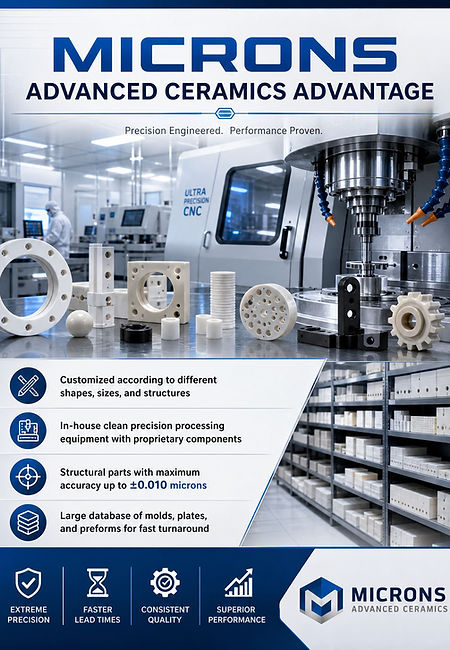
Microns Advanced Ceramics Advantage
-
Customized according to different shapes, sizes, and structures
-
In-house clean precision processing equipment with proprietary components
-
Structural parts with maximum accuracy up to ر0.010 microns
-
Large database of molds, plates, and preforms for fast turnaround
Your Trusted Boron Nitride Ceramic
Boron nitride is a crystal composed of nitrogen and boron atoms (BN), with properties such as low friction, lubrication, light weight, and moisture absorption.
Boron nitride is mainly available in hexagonal phase (h-BN), used for high-temperature and electrical insulation applications, and cubic phase (c-BN), used for cutting tools and abrasives due to its hardness second only to diamond.


Boron Nitride Products
The thermal conductivity of boron nitride ceramic is similar to metal and widely used in applications requiring efficient heat dissipation. Boron nitride ceramics resist high temperatures and can work in environments above 2000°C, with a layered structure similar to graphite that provides self-lubricating properties under high temperature and pressure.

Boron Nitride Ceramic Crucible

Boron Nitride Conical Crucible

Boron Nitride Small Crucible
Thermal Performance
Excellent thermal stability at temperatures reaching 1000°C
Electrical Properties
Good dielectric strength, low loss, strong insulation
Mechanical Properties
Anti-abrasive, low wear, good lubricity
Chemical Properties
Non-toxic, chemically stable, corrosion resistant
Features of Boron Nitride Ceramic
The Difference Between Hexagonal (h-BN) and Cubic (c-BN) Boron Nitride
Hexagonal and cubic boron nitride are both BN crystal phases, but their different crystal structures give them significantly different properties.
Hexagonal boron nitride (h-BN) has lower mechanical strength but good heat and corrosion resistance, used for high-temperature and electrical insulation applications. Cubic boron nitride (c-BN) has hardness second only to diamond, making it well suited to cutting tools and abrasives.

Mechanical Properties of Boron Nitride Ceramic
Physical Properties of Boron Nitride Ceramic


Why Choose Microns Advanced Ceramics Boron Nitride Products
We're equipped with full-process precision monitoring and testing instruments — particle size distribution testers, powder oxygen content testers, and 3D coordinate testers — covering the full process from raw materials to finished parts.
We produce components for heat sink chassis, semiconductor packaging, and other demanding applications. If you have a project requiring boron nitride ceramics, we have the processing equipment to deliver it.

Boron Nitride Ceramic for Different Industries

5pm-8pm
DAILY
Automotive
Used in engine components, bearings, turbochargers, and EGR valves for high strength, thermal stability, and wear resistance.

5pm-8pm
DAILY
Aerospace
Used for turbine blades, combustion liners, and heat shields — lightweight, high-temp resistant, with excellent mechanical properties.

5pm-8pm
DAILY
Electronic Devices
Used for substrates, insulators, and packages due to excellent electrical insulation and thermal conductivity.

5pm-8pm
DAILY
Energy and Power
Applications in gas turbines, solar cells, heat exchangers, and nuclear sensors, aided by thermal shock resistance.

5pm-8pm
DAILY
Cutting Tools and Abrasives
High hardness and thermal stability suit machining, grinding, and cutting operations.
Silicon Nitride Ceramic Production Process

Frequently Asked Questions
What is the difference between hexagonal and cubic boron nitride?
h-BN has a graphite-like layered structure with good heat resistance and insulation, while c-BN has a diamond-like structure with much higher hardness, suited to cutting tools and abrasives.
Is boron nitride ceramic electrically insulating?
Yes — h-BN in particular offers excellent electrical insulation combined with good thermal conductivity.
Can boron nitride withstand very high temperatures?
Yes, boron nitride maintains stability at high temperatures, with h-BN commonly used above 2000°C in inert or vacuum conditions.
Why is boron nitride considered self-lubricating?
Yes, boron nitride maintains stability at high temperatures, with h-BN commonly used above 2000°C in inert or vacuum conditions.