


Ceramic vs PEEK Plastic Components: Cost, Durability, and Performance


Selecting between technical ceramics and PEEK (Polyether Ether Ketone) components is a common engineering decision in semiconductor, industrial processing, medical, and energy applications. Both materials offer excellent performance compared to conventional metals and plastics but they solve different design problems. Understanding the trade-offs in cost, durability, machinability, and long-term reliability helps procurement teams and design engineers select the right material for the application—not simply the lowest initial purchase price.
Need Help Selecting the Right Material?
Choosing between technical ceramics and PEEK depends on operating temperature, wear conditions, tolerances, chemical exposure, and production requirements. If you're sourcing a custom component, MAC's engineering team can review your drawings and recommend the most suitable material before production begins.
What Are Technical Ceramic and PEEK Components?
Technical ceramics are engineered inorganic materials manufactured for high-performance industrial environments. Unlike structural ceramics used in construction, advanced ceramics are designed to provide exceptional hardness, wear resistance, electrical insulation, chemical stability, and dimensional accuracy.
Common engineering ceramic materials include:
Alumina ($\text{Al}_2\text{O}_3$)
Zirconia ($\text{ZrO}_2$)
Silicon Carbide ($\text{SiC}$)
Silicon Nitride ($\text{Si}_3\text{N}_4$)
PEEK is a high-performance thermoplastic widely used when lightweight construction, chemical resistance, and moderate mechanical strength are required. It can be machined, injection molded, or compression molded into complex parts and is commonly specified as an alternative to metal or lower-grade engineering plastics.
While both materials occupy the premium end of the engineering materials spectrum, their performance envelopes differ significantly.
Technical Property Comparison
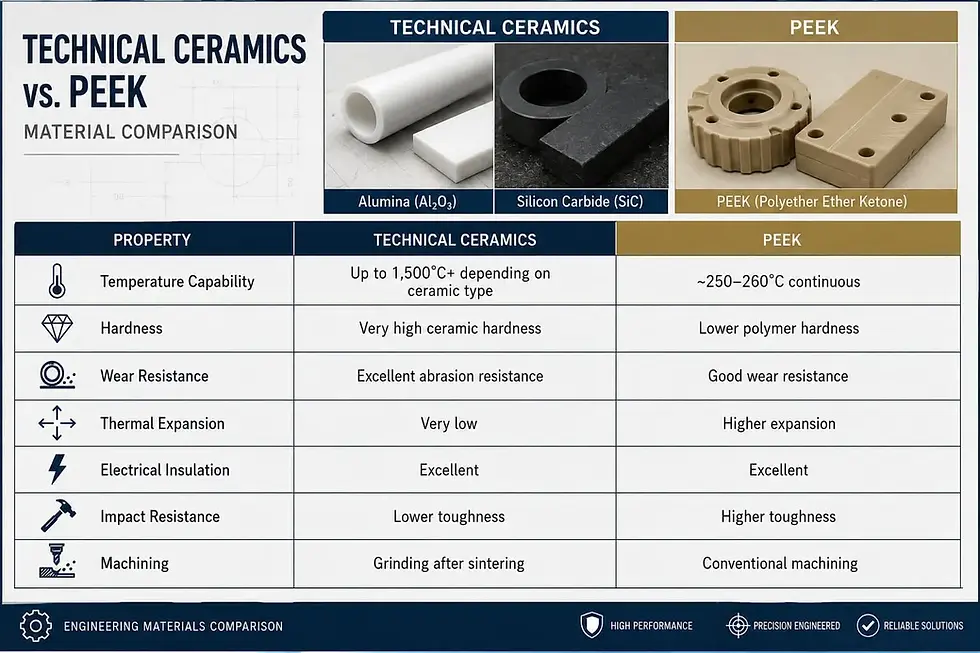
Property | Technical Ceramics | PEEK |
Maximum Continuous Service Temperature | Alumina: ~1,500°C; Silicon Carbide: >1,400°C; Silicon Nitride: ~1,200°C | ~250–260°C continuous |
Hardness | Extremely high (Alumina ~15–20 GPa Vickers) | Significantly lower |
Wear Resistance | Excellent | Good |
Chemical Resistance | Outstanding against most acids, alkalis, and solvents | Excellent against many chemicals but limited by certain concentrated acids and oxidizers |
Electrical Insulation | Excellent (Alumina, Zirconia) | Excellent |
Thermal Conductivity | Material dependent ($\text{SiC}$ high, Alumina moderate) | Low |
Thermal Expansion | Very low | Higher than ceramics |
Impact Toughness | Lower (brittle material) | Much higher |
Machinability | Diamond grinding after sintering | Conventional machining possible |
Typical Component Cost | Higher manufacturing cost | Lower for many moderate-performance applications |
Note: Values vary by grade and manufacturer specifications.
Cost Comparison: Initial Price vs Lifetime Value
Many purchasing decisions begin with unit price, but industrial components should be evaluated based on total lifecycle cost.
PEEK generally offers:
Lower machining costs
Faster prototype production
Lower tooling investment for molded parts
Reduced part weight
Technical ceramics generally require:
Precision grinding
Specialized processing
Longer manufacturing cycles
Higher production costs
However, the purchase price often represents only a small fraction of the total ownership cost. When operating in abrasive, corrosive, or high-temperature environments, ceramic components frequently outlast polymer alternatives by several multiples, reducing:
Scheduled maintenance
Equipment downtime
Replacement inventory
Production interruptions
For semiconductor tools, chemical processing equipment, and wear-intensive industrial machinery, longer service intervals often justify the higher initial investment.
Durability and Wear Performance
Durability is where technical ceramics typically outperform high-performance polymers.
Technical Ceramics
Engineering ceramics provide:
Exceptional abrasion resistance
Minimal wear under sliding contact
Outstanding dimensional stability
Resistance to deformation under high loads
Long service life in particulate environments
Alumina, silicon carbide, and silicon nitride are widely used for pump seals, bearings, valve seats, guide rollers, semiconductor handling components, and precision positioning systems. Their hardness allows them to maintain tight dimensional tolerances over extended operating periods.
PEEK
PEEK offers excellent durability for a thermoplastic but exhibits:
Higher wear rates under abrasive conditions
Surface deformation under heavy mechanical loads
Greater creep during long-term loading
Faster dimensional changes at elevated temperatures
Filled PEEK grades (glass-filled or carbon-filled) improve wear performance but generally do not match advanced ceramics in highly demanding industrial environments.
Temperature Performance
Temperature capability is often the deciding factor.
Ceramic Components
Most advanced ceramics retain mechanical properties at temperatures far beyond the operating limits of engineering plastics. For example:
Alumina performs well in continuous high-temperature environments.
Silicon carbide maintains strength while providing excellent thermal conductivity.
Silicon nitride offers outstanding thermal shock resistance.
Many ceramic grades remain stable well above 1,000°C depending on composition and operating atmosphere.
PEEK Components
PEEK is one of the highest-performing engineering thermoplastics available. Typical performance includes:
Continuous service around 250–260°C
Short-term exposure reaching up to 300°C depending on the specific grade and load conditions
Excellent dimensional stability compared to most plastics
However, above its operating range, mechanical properties decline significantly.
Chemical Resistance
Both materials demonstrate strong chemical resistance, but their suitability depends on the process environment.
Technical ceramics resist strong acids, alkalis, solvents, oxidizing environments, and high-purity process chemicals.
PEEK performs exceptionally well against hydrocarbons, organic solvents, steam, and many industrial chemicals.
Certain concentrated oxidizing acids may attack PEEK under specific conditions, making ceramics the preferred option for aggressive chemical processing systems.
Precision and Dimensional Stability
OEMs supplying semiconductor, automation, and precision manufacturing equipment frequently prioritize dimensional consistency over simple material strength.
Technical ceramics offer:
Very low thermal expansion
Excellent rigidity
Stable geometry across temperature changes
Long-term dimensional repeatability
Precision ceramic manufacturers routinely produce tight tolerances through advanced grinding and finishing processes. Actual achievable tolerances depend on geometry, material, and manufacturing method, with many precision features requiring diamond grinding after sintering.
For components where dimensional accuracy, material selection, and manufacturability directly affect equipment performance, early engineering collaboration can reduce redesigns and improve production outcomes.
MAC's engineering team can review your drawings and recommend the appropriate ceramic material, manufacturing process, and achievable tolerances for your application.

Conversely, PEEK is easier to machine but experiences greater thermal expansion and long-term creep than ceramic materials.
Typical Industrial Applications
Applications Best Suited for Technical Ceramics

Semiconductor wafer handling components
Vacuum system insulators
Mechanical seals and ceramic bearings
Pump components and wear-resistant nozzles
High-temperature furnace fixtures
Chemical processing equipment
Precision insulating components
Applications Best Suited for PEEK
Lightweight structural parts
Electrical connectors
Medical device components
Valve bodies and pump housings
Aerospace interior components
Low-friction bushings
Instrumentation components
In many assemblies, ceramic and PEEK components are used together, each selected for the properties required at specific locations within the system.

How to Choose Between Ceramic and PEEK Components
The material selection process should begin with the application's operating conditions rather than material preference.
Choose technical ceramics when your application requires:
Continuous high-temperature operation
Extreme wear resistance
Maximum dimensional stability
Electrical insulation in harsh environments
Long service life and high compressive strength
Resistance to aggressive chemicals
Choose PEEK when your application requires:
Lower component weight
Better impact resistance
Easier machining and faster prototyping
Moderate operating temperatures
Complex geometries produced economically
The correct decision often depends on balancing initial manufacturing costs against long-term operational performance.
Why Material Selection Matters for OEM Manufacturing
For OEMs operating in semiconductor manufacturing, EV battery production, oil and gas, chemical processing, and industrial automation, material selection directly influences equipment reliability. Premature component failure increases maintenance costs, interrupts production schedules, and can affect process consistency.
Working with an experienced technical ceramic manufacturer during the design phase helps engineers evaluate geometry, tolerances, manufacturability, and material selection before production begins. This collaborative approach can reduce redesign cycles while improving long-term component performance.
Microns Advanced Ceramics manufactures precision technical ceramic components for demanding industrial applications, supporting OEMs with engineered ceramic solutions designed to meet strict quality and dimensional requirements. Manufacturing capabilities should be confirmed for specific materials, tolerances, and production volumes during the quoting process.
Key Takeaways
Performance Limits: Technical ceramics outperform PEEK in extreme temperatures, wear resistance, and long-term dimensional stability.
Prototyping & Weight: PEEK offers advantages in impact resistance, machinability, lightweight design, and lower initial manufacturing cost.
Lifecycle Value: Total lifecycle cost often favors ceramics in abrasive, corrosive, or high-temperature industrial applications.
Holistic Selection: Material selection should be based on operating conditions, performance requirements, and expected service life rather than purchase price alone.
Early Collaboration: Consulting with an experienced ceramic manufacturer early in the design process helps optimize component performance, manufacturability, and sourcing efficiency.
Ready to Evaluate Ceramic vs. PEEK for Your Application?
Choosing the right material is ultimately an engineering decision that balances performance, manufacturability, lifecycle cost, and reliability. Whether you're designing a new OEM component or replacing an existing PEEK or metal part, Microns Advanced Ceramics works with engineering and procurement teams to manufacture precision technical ceramic components for demanding industrial environments.
Submit your drawings, specifications, or application requirements, and our engineering team will review your project to help determine the most appropriate ceramic material and manufacturing approach.
Or explore our Custom Technical Ceramic Components Manufacturer page to learn more about our manufacturing capabilities and material options.


Comments